 USA
 Canada
 Brazil
 Germany
 France
 Italy
 Switzerland
 Sweden
 Spain
 Great Britain
 Norway
 Russia
 South Africa
 Japan
 Australia

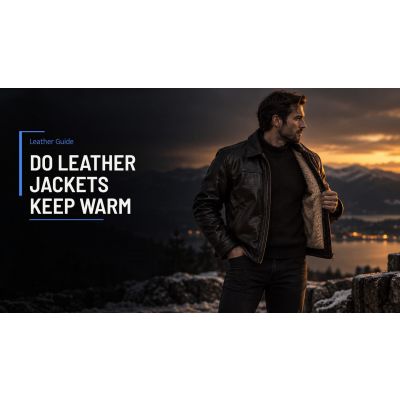
Short answer: A leather jacket is warm against wind, not against cold. Leather stops air very well, but a thin hide adds little insulation, so the lining and the layers under it set how cold a day you can handle. An unlined jacket suits mild weather, a quilted lining stretches that into cool weather, and a shearling lining is for cold.
Temperature bands by lining
These are rough rules of thumb for a person walking or commuting, wearing a base layer and a sweater. They are not lab ratings. Your own comfort, how long you are outside and the wind will shift them.
| Jacket type | Comfortable roughly from | Notes |
|---|---|---|
| Unlined leather (thin lambskin or cowhide) | About 55 to 70 F (13 to 21 C) | Cooler with a sweater, but the jacket itself adds little warmth |
| Quilted or fleece-lined leather | About 40 to 55 F (4 to 13 C) | The lining traps air; check how thick it is |
| Shearling or fur-lined leather | About 15 to 40 F (-9 to 4 C) | The warmest option; heavier and bulkier |
Treat the edges of each band as the point where you need to add or remove a layer.
Why leather feels cold at first
Leather is a dense, fibrous material with no open weave, so wind can barely get through it. But it also conducts heat away from your body when you first put it on in a cold room or after a cold car. That cold touch fades as the jacket warms to body temperature.
Fit changes the result. A jacket that is too loose lets air circulate inside and carries heat away. A snug cut with enough room for a thin layer keeps a pocket of warm air next to your body.
Riding wind chill
On a motorcycle, speed adds to the wind. The National Weather Service publishes a wind chill formula that turns air temperature and wind speed into a "feels like" figure. It is defined only for temperatures at or below 50 F and wind above 3 mph, so the table starts at 50 F. Using that formula, rounded, the table shows what steady wind at 60 mph does to the feel of the air.
| Air temperature | Feels like at 5 mph | Feels like at 60 mph |
|---|---|---|
| 50 F (10 C) | 48 F | 39 F (4 C) |
| 40 F (4 C) | 36 F | 25 F (-4 C) |
| 30 F (-1 C) | 25 F | 10 F (-12 C) |
The index describes bare skin. A jacket protects your torso, so you will not feel as cold as the table says. But it shows why a 50 F morning can feel like 39 F at highway speed, and why riders layer sooner than walkers. See the National Weather Service wind chill chart for the full range.
This is where leather helps most. A leather shell blocks the moving air that strips heat from your layers, so it does more at 60 mph than a thin fabric jacket that lets air through the weave.
Layering under a leather jacket
Use three layers when it gets properly cold.
- Base layer. A thermal top or merino shirt that moves sweat off your skin.
- Mid layer. A knit sweater, a fleece or a light down vest for insulation.
- Shell. The leather jacket, which blocks wind and holds the warm air in.
Leave room for the layers. Try the jacket on with the sweater you plan to wear, because layers that are squashed lose their insulating air. Our guide to layering a leather jacket across seasons has outfit ideas, and the post on seasonal leather styling covers what changes between summer and winter.
Warmth by leather type
- Lambskin: light and soft, with the least insulation of the three. Good for mild weather.
- Cowhide: thicker and heavier. It blocks wind well and holds its shape, though it is stiffer at first.
- Shearling: sheepskin tanned with the wool left on, so the wool itself is the insulation. See our explainer on shearling, sheepskin and sherpa for the differences.
Thickness matters more than the name of the leather. Check the product page for hide thickness and weight when it is listed.
Features that add warmth
- Storm flap: a strip of leather behind the zip that blocks air through the teeth.
- Snug cuffs: adjustable or knitted cuffs stop cold air running up your sleeves.
- High collar: a stand-up or snap-down collar closes the gap at your neck.
- Zip-in liner: a removable liner lets one jacket cover two seasons.
Try the zip, collar and cuffs closed before you decide. Gaps are where the heat escapes.
Choosing for your climate
| Your winter | Start with |
|---|---|
| Mild, rarely below 50 F | Unlined leather with a sweater |
| Cool, 35 to 50 F | Quilted or fleece-lined leather with layers |
| Cold, below freezing at times | A shearling-lined style, or a brown fur-lined leather jacket with a base layer |
| Long rides in the cold | Warm lining, wind-tight cuffs and collar, and layers under the jacket |
If you want a longer cut for deep winter, look at men's leather coats, which cover more of the body than a jacket does.
Common mistakes
- Buying tight and planning to add layers later. A jacket that fits only over a T-shirt will compress a sweater and feel colder, not warmer.
- Judging warmth by weight. A heavy cowhide jacket with a thin lining can feel colder than a lighter jacket with a good quilted lining.
- Forgetting the neck and hands. Heat escapes at the collar and cuffs. A scarf and gloves often add more comfort than a thicker jacket.
- Riding in the same layers you walk in. Because of wind chill, add one layer more than you would for a walk at the same temperature.
A quick pre-winter checklist
- Try the jacket on over the heaviest sweater you will wear.
- Check that the zip closes fully and the collar sits close to your neck.
- Look at the lining label or product page to see what fill or fleece it uses.
- Condition the leather before the cold season so it stays supple.
Care when it gets wet
If your jacket gets wet, let it dry slowly at room temperature, away from radiators and heaters. Heat dries the hide too fast and can stiffen it. The Canadian Conservation Institute gives similar advice for leather objects.
FAQs
Are leather jackets warm in winter?
Yes, if the lining and layers match the weather. Leather blocks wind, while the lining and your clothing underneath provide the insulation.
Is leather warmer than cotton or denim?
Against wind, yes, because leather has no open weave. For insulation on a still day, thickness and lining matter more than the material.
What temperature is a leather jacket good for?
An unlined jacket is comfortable in mild weather, roughly 55 to 70 F with a sweater. A quilted lining extends that, and shearling covers colder days. These are guides and not tested ratings.
Do leather jackets keep wind out?
Very well. The hide is solid, so the main gaps are the zip, collar and cuffs. A storm flap and snug cuffs help.
How do I layer under a leather jacket?
Wear a thermal base layer, a knit or fleece mid layer and the jacket on top. Choose a size that fits over the mid layer without squashing it.
Is a shearling jacket warmer than a lined leather jacket?
Usually. Shearling uses the wool of the skin as insulation, which is warmer than a thin quilted or fleece lining. It is also heavier and bulkier.
For deep-winter wear, browse our men's leather coats and pick a lining that matches your climate.