
 USA
 Canada
 Brazil
 Germany
 France
 Italy
 Switzerland
 Sweden
 Spain
 Great Britain
 Norway
 Russia
 South Africa
 Japan
 Australia

Choosing a leather jacket for everyday wear feels straightforward until you stand in front of options that look similar but cost very differently, fit very differently, and will age very differently. The confusion starts fast: Is this lambskin or cowhide? Does the lining matter? Will it fit after a few wears? Why does one jacket feel supple while another feels stiff? A poor choice means spending money on something that either restricts your movement, wears out quickly, or simply does not match how you actually dress. The right choice means owning a piece that fits your body, suits your climate, handles your lifestyle, and improves with age.
Buying a leather jacket for everyday wear is different from buying one for occasional events. Daily wear means your jacket needs to move with you, breathe appropriately for your climate, resist creasing and scuffing, and remain comfortable through multiple wears per week. This guide walks you through what to actually look for, what separates quality leather jackets from mediocre ones, and how to avoid costly mistakes before you buy.
Quick Buying Advice:
Before comparing styles or prices, identify your intended use and climate. A lightweight lambskin jacket works beautifully for mild weather and careful wear, while a thicker cowhide jacket handles cold weather and daily wear better. Check the leather grain, stitching consistency, and lining quality in person or through detailed photos. Confirm fit around the shoulders, chest, and sleeves without excessive pulling or bunching. Verify the leather type and thickness on the product description. Only then compare prices and customization options.
- What Should Buyers Know Before Buying a Leather Jacket?
- How to Choose the Right Leather Jacket for Your Lifestyle
- What Quality and Construction Features Should You Check?
- How Fit and Sizing Affect Comfort and Appearance
- Which Leather Types and Materials Matter Most?
- Standard Size vs Custom Size: Which Should You Choose?
- Final Buying Advice from Leather Collection
What Should Buyers Know Before Buying a Leather Jacket?
A leather jacket is not a static product. The leather will soften, develop a patina, show creases and character marks, and change color slightly over time. This is not wear-out; it is aging. Understanding this difference changes how you evaluate leather jackets before buying. A jacket that looks slightly imperfect in the grain or shows natural color variation is not defective—it is authentic leather. A jacket with perfectly uniform color and zero texture variation might be lower-grade leather or heavily treated to hide natural characteristics.
Leather thickness affects how a jacket looks, feels, and performs. Thinner leather (0.8–1.2 mm) feels softer and more flexible immediately, drapes better, and weighs less. It suits mild weather and careful wear. Thicker leather (1.2–1.5 mm or more) feels structured, resists creasing, handles rough daily use, and lasts longer. It suits cold weather and frequent wear. Neither is automatically better—your lifestyle, climate, and comfort preference determine which matters more.
Leather jackets require maintenance. A quality leather jacket will not rot or fall apart, but it benefits from occasional conditioning to keep the leather supple and protect it from drying out. Dust and dirt should be wiped off regularly. Stains may require professional cleaning. This is not a burden for most owners—it is part of owning a product that improves with care.
How to Choose the Right Leather Jacket for Your Lifestyle
Start by answering three questions about your intended use: Where will you wear it most? What is your typical climate? How often will you wear it? These answers determine whether you need a lightweight fashion jacket, a structured everyday jacket, or a heavy-duty work jacket. A customer buying a leather jacket for casual weekend wear in mild weather has completely different needs from someone buying one for commuting through winter or working outdoors.
A leather jacket for everyday wear in a temperate climate should balance structure with comfort. You need enough weight to hold its shape through regular wear, but not so much that it becomes a burden on warm days. The jacket should feel comfortable over a t-shirt, a long-sleeve shirt, and a light sweater. Test this range if possible before buying. A jacket that feels perfect over a single layer might be restrictive over multiple layers, and vice versa.
Climate matters significantly. Cold-weather wear demands thicker leather, substantial lining, and secure closures that keep wind and cold out. Mild-weather wear can use thinner, more breathable leather. Rainy climates benefit from leather that has been treated or conditioned to resist water absorption. Hot climates need lightweight leather that does not trap heat. Your location and season should shape your choice as much as your personal style.
Buyers comparing leather clothing for everyday wear can explore our
for styles designed around fit, comfort, and long-term wear.What Quality and Construction Features Should You Check?
Leather grade is the first quality signal. Full-grain leather includes the entire hide surface with its natural grain and texture intact. It is the most durable and develops character beautifully. Top-grain leather has the outer surface sanded smooth and often treated with finish to create a uniform appearance. It is still quality leather but slightly less durable than full-grain. Genuine leather is a broad category that includes lower-grade leather scraps bonded together. It is cheaper but significantly less durable. Avoid any product labeled only as "genuine leather" without additional specification about the hide quality.
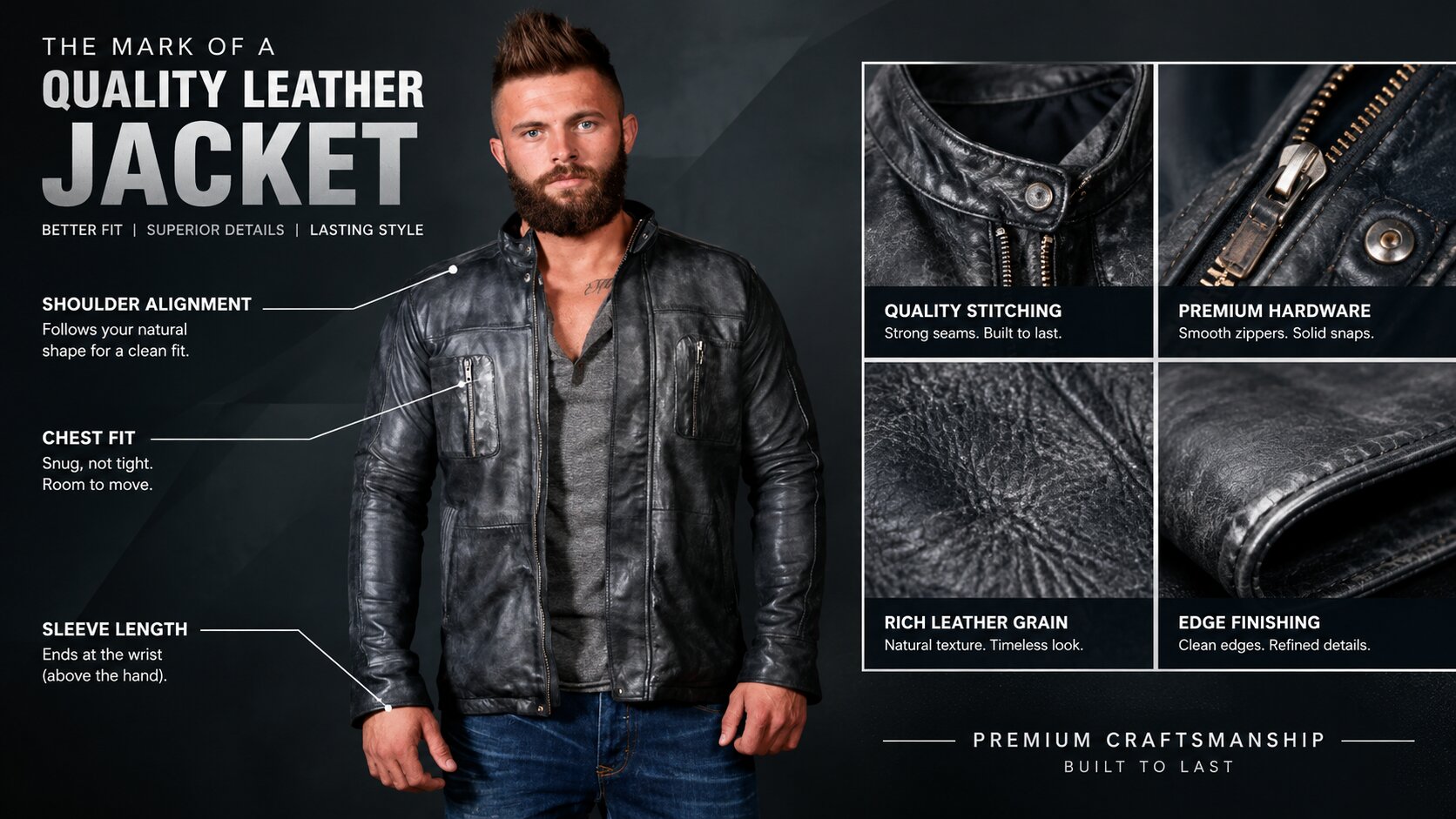
Stitching quality separates leather jackets that last from those that fail. Run your eye along seams, closures, and reinforcement areas. Stitches should be consistent in length, evenly spaced, and tight. Loose or irregular stitching is a red flag—it indicates the seams may fail under stress. Reinforced seams, especially around the shoulders, armpits, and pocket areas, show that the maker anticipated where stress occurs. Look for stitching that goes through the leather cleanly without puckering or bunching the material.
Hardware—zippers, snaps, buttons, and D-rings—should feel substantial and move smoothly. Cheap hardware corrodes, sticks, or breaks after months of use. Quality zippers glide without catching. Snaps and buttons should be firmly attached and sit flush against the leather. Examine the zipper pull, the snap base, and button shanks. If they feel thin or flimsy in your hand, they will fail faster than the leather itself.
Lining material and attachment matter for comfort and durability. A quality lining should be sewn or glued securely to the leather, not loose or peeling. Natural fiber linings (cotton, linen) breathe better than synthetic linings but may require more care. Synthetic linings resist moisture better but can feel clammy in warm weather. The lining should cover all interior seams and rough edges so nothing scratches your skin during wear. Pockets should be reinforced at the corners where stress concentrates.
Edge finishing is a detail that shows craftsmanship. Leather edges should be smooth, sealed, or bound with a contrasting edge strip. Rough or frayed edges indicate lower-quality construction and will worsen with use. High-quality jackets often feature burnished edges where the leather is sanded and sealed to a smooth finish.
How Fit and Sizing Affect Comfort and Appearance
Fit is the most important factor in a leather jacket for everyday wear, and it is also the most commonly misjudged. A jacket that fits poorly will never feel right, no matter how good the leather quality. Poor fit also stresses seams and hardware unevenly, causing premature failure in tight areas. A well-fitted jacket moves with your body, looks intentional, and lasts longer.
Shoulders are the primary fit point. The shoulder seam should sit right at the edge of your shoulder bone. If it pulls when you reach forward or backward, the jacket is too tight across the upper body. If it hangs past your shoulder point, the jacket is too large. Reach forward with both arms—your shoulders should move freely without pulling the jacket fabric. Rotate your arms in circles—you should complete full rotations without restriction.
Chest fit determines whether the jacket looks tailored or sloppy. Zip or button the jacket and stand naturally. The front should close without pulling or gaping. If you cannot close it comfortably or if it pulls across the chest when you do, the jacket is too small. If it closes with significant excess fabric bunching at the sides, the jacket is too large. A proper fit means the jacket sits smoothly against your chest without excess material or strain.
Sleeve length affects both appearance and function. Sleeves should end at your wrist bone, not covering your hands or leaving your wrists exposed. When your arms hang naturally, the sleeve should reach to the base of your thumb. Push your arms forward as if reaching for something—your sleeves should not ride up past your wrist. Sleeve length that is even slightly off looks awkward and limits the jacket's versatility across different layering situations.
Waist fit determines comfort during movement and sitting. A leather jacket should not restrict your waist or hips. Sit down in the jacket and check that it does not pull across your abdomen or lower back. Stand and reach your arms across your body—the sides should not pull. A jacket that fits perfectly standing may become uncomfortable when sitting if the waist is too tight. For everyday wear, comfort during normal movement matters more than a slim silhouette.
Length affects both appearance and function. A standard leather jacket for everyday wear should end at your hip bone or slightly below. Too short and it looks like you are wearing a child's jacket. Too long and it overwhelms your frame and catches on chair backs. Cropped jackets are a style choice, but standard length is more versatile for everyday wear across different body types and outfits.
Many buyers make the mistake of assuming leather will stretch significantly into a better fit. Modern quality leather does stretch and soften with wear, but do not count on major size changes. A jacket that is snug at purchase might become comfortable after several wears, but one that is genuinely too tight will never feel right. Buy for the fit you need now, not the fit you hope it becomes.
Which Leather Types and Materials Matter Most?
Cowhide is the most common leather for everyday wear jackets. It is durable, structured, and resists creasing better than softer leathers. Cowhide develops a rich patina over time and handles daily wear without showing every mark. It is heavier than lambskin and requires longer to break in, but once it does, it becomes incredibly comfortable. Cowhide suits cold weather, frequent wear, and buyers who want a jacket that improves with age. The trade-off is that cowhide feels stiffer initially and may show creases more obviously during the break-in period.
Lambskin is softer, lighter, and more supple than cowhide. It feels luxurious immediately and drapes beautifully. Lambskin suits mild weather, careful wear, and buyers who prioritize immediate comfort and softness over durability. The trade-off is that lambskin creases more easily, shows wear faster, and requires more careful handling. A lambskin jacket works well for someone who wears it occasionally or in a climate where heavy leather is unnecessary. It is less ideal for someone who wears the same jacket multiple times per week in variable weather.
Buffalo leather is thicker and more textured than cowhide. It resists scratching and creasing exceptionally well and develops a beautiful patina. Buffalo leather suits buyers who want maximum durability and do not mind a heavier, more structured jacket. The trade-off is that buffalo leather is heavier, takes longer to soften, and may feel stiff initially. It is excellent for cold-weather wear and frequent use.
Goatskin is lighter than cowhide but more durable than lambskin. It offers a middle ground—softer than cowhide, more structured than lambskin. Goatskin works well for buyers who want a leather jacket that is comfortable immediately but still durable for everyday wear. It develops character with age and handles frequent wear reasonably well.
Sheepskin is the softest leather and works best for lining or trim rather than as the primary jacket material. A sheepskin-lined leather jacket provides warmth and comfort without requiring the entire jacket to be sheepskin.
Leather finish affects appearance, texture, aging, and maintenance. Aniline leather is dyed throughout and shows the natural grain clearly. It looks authentic, ages beautifully, and requires regular conditioning. It stains more easily and requires more care. Semi-aniline leather has a thin protective coating over the dye, offering some stain resistance while still showing grain. Pigmented leather has a thick colored coating that hides the grain and resists staining and scratching. It looks more uniform but does not age as interestingly. Distressed or vintage leather is intentionally treated to look aged, which appeals to some buyers but may hide quality issues.
When is it worth paying more for leather? Premium leather costs more because it comes from better hides with fewer natural marks, is tanned using better methods that preserve durability, and is cut and finished with more care. A full-grain cowhide from a premium tannery will outlast lower-grade cowhide by years. Premium leather also develops a more attractive patina because the tanning process preserved the leather's character. If you plan to wear the jacket frequently for years, premium leather is worth the cost. If you are buying your first leather jacket and uncertain about your commitment, a mid-grade leather jacket from a reputable maker is a smarter starting point.
Standard Size vs Custom Size: Which Should You Choose?
Standard sizes work well for most buyers. Leather Collection and other quality makers use size charts based on thousands of measurements, so standard sizes fit the majority of people reasonably well. If your measurements fall within the standard range for a size, standard sizing is faster, cheaper, and often just as comfortable as custom sizing.
Custom sizing makes sense when your proportions fall outside typical ranges or when you want a more precise fit. A person with very long arms, a short torso, or non-standard chest-to-waist proportions may find that standard sizes never fit quite right. Someone with a 44-inch chest but 30-inch sleeves, for example, would struggle to find a standard jacket that fits both measurements. Custom sizing solves this problem by tailoring each dimension to your actual measurements.
Custom sizing also appeals to buyers who have had poor experiences with standard sizing or who want maximum precision. If you have spent years finding that jackets fit slightly wrong, custom sizing can be transformative. The trade-off is that custom sizing adds cost and lead time. Your jacket takes weeks to make rather than arriving in days.
Before choosing custom sizing, verify your measurements carefully. Measure your chest, waist, hips, shoulder width, sleeve length, and jacket length using a soft tape measure and a helper if possible. Compare these measurements to the standard size chart. If you fall between sizes or if one dimension is significantly different from the standard, custom sizing is worth considering. If your measurements align well with a standard size, buy standard and save the money and wait time.
Final Buying Advice from Leather Collection
Choosing a leather jacket for everyday wear comes down to three core decisions: identifying the right leather type for your climate and wear frequency, confirming that the fit matches your body without compromise, and verifying that the construction quality will support years of use. Before you buy, create a checklist of what matters most to you—softness, durability, structure, weight, or aging character. Different leather types and grades prioritize these qualities differently. No single leather jacket is best for every buyer.
Common buying mistakes include choosing a jacket based on appearance alone without testing the fit, assuming leather will stretch enough to correct a poor initial fit, buying based on price without checking construction quality, and selecting a leather type that does not match the intended use. Avoid these mistakes by prioritizing fit first, examining construction in detail, and choosing leather that suits your actual lifestyle rather than an imagined one.
Before placing an order, verify the leather type and thickness in the product description. Request detailed photos of the stitching, hardware, lining, and leather surface if you are buying online. Confirm the size using the provided measurements and a soft tape measure. Check the return policy in case the fit is not right. Read reviews from other buyers with similar body types or climate needs. Ask the maker any questions about construction, leather origin, or care before buying.
For buyers ready to explore leather jackets designed for everyday comfort and durability, the
demonstrates how leather quality, construction details, and thoughtful fit work together in a jacket built to last.A well-chosen leather jacket for everyday wear becomes part of your life for years. It moves with you, improves with age, and develops a character that reflects how you actually live. The time you spend choosing correctly now pays dividends every time you wear it.
FAQs
What is the best leather type for a jacket I will wear every day?
Cowhide is the best everyday leather because it balances durability, structure, and aging character. Cowhide resists creasing better than softer leathers, handles frequent wear without showing every mark, and develops a rich patina over time. It is heavier than lambskin and feels stiffer initially, but once broken in, it becomes incredibly comfortable. If you live in a cold climate or wear the same jacket multiple times per week, cowhide is the clear choice.
How much should a quality leather jacket cost?
A quality leather jacket for everyday wear typically costs between $400 and $1,500 depending on leather grade, construction quality, and customization. Entry-level quality jackets start around $400–$600 and use mid-grade leather with solid construction. Premium jackets range from $800–$1,500 and use full-grain leather from better tanneries with meticulous construction. Custom sizing adds $100–$300 to the base price. Avoid jackets under $300, which typically use lower-grade leather that will not last.
Will a leather jacket stretch to fit better after I buy it?
Quality leather does stretch and soften with wear, but the change is gradual and modest—typically a half-size or less. A jacket that fits snugly at purchase may become comfortable after several weeks of regular wear. However, do not buy a jacket that is genuinely too tight hoping it will stretch into the right fit. A jacket that pulls across the chest or shoulders will never feel right, and the stress from stretching will damage seams and hardware. Buy for the fit you need now, not the fit you hope for later.
What is the difference between full-grain and top-grain leather?
Full-grain leather includes the entire hide surface with its natural grain and texture intact. It is the most durable, develops character beautifully, and shows the leather's authentic appearance. Top-grain leather has the outer surface sanded smooth and often treated with finish to create a uniform look. It is still quality leather but slightly less durable than full-grain and does not age as interestingly. For everyday wear, full-grain leather is worth the higher cost because it lasts longer and improves with age.
Should I choose a lined or unlined leather jacket?
A lined jacket is better for everyday wear. The lining protects the interior seams from wear, prevents the leather from sticking to your skin in warm weather, and provides warmth in cold weather. A quality lining should be sewn securely and cover all rough interior edges. Unlined jackets are lighter and more breathable but expose interior seams to wear and can feel uncomfortable against bare skin. For a jacket you will wear frequently, lining is worth the weight.
How do I know if a leather jacket will fit before I buy it online?
Measure your chest, shoulders, sleeve length, and jacket length using a soft tape measure. Compare these measurements to the product size chart provided by the maker. Request detailed photos of the fit on a model with similar proportions to yours. Read reviews from other buyers with your body type. Contact the maker with specific questions about fit if you are uncertain. Consider ordering from a maker with a generous return policy so you can return the jacket if it does not fit as expected.