
 USA
 Canada
 Brazil
 Germany
 France
 Italy
 Switzerland
 Sweden
 Spain
 Great Britain
 Norway
 Russia
 South Africa
 Japan
 Australia

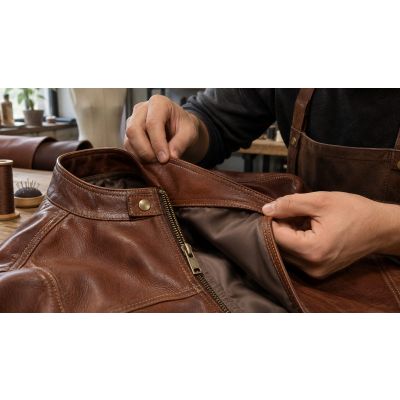
Short answer: Check five things: the leather and how it feels, the stitching, the zip and hardware, the lining and pockets, and how the jacket hangs and moves on you. A poor jacket usually fails on two or more. Use the ten-point checklist at the end in a store or when you compare online listings.
Leather first: grade and feel
Grade names are used loosely, so learn what they mean.
- Full-grain: the top layer of the hide with the natural grain intact. It shows marks and ages well.
- Top-grain: the top layer, sanded to remove marks, then finished. Smoother and more uniform, slightly less durable.
- Genuine leather: real leather, but often a lower layer. It does not signal high quality.
- Bonded leather: scraps glued together with a coating. It peels over time.
Read full-grain vs top-grain leather and genuine leather labels explained for more. To spot imitations, see how to tell real leather from fake.
Physical tests:
- Flex test: bend a sleeve. Good leather wrinkles in fine lines and relaxes. A hard coating cracks or looks plastic.
- Pinch test: pinch the leather. Real hide wrinkles and returns slowly.
- Smell: real leather has an earthy smell. A chemical, sharp smell suggests heavy coating.
- Weight: thicker is not automatically better. See the leather thickness guide.
Stitching and seams
Look at the seams in good light.
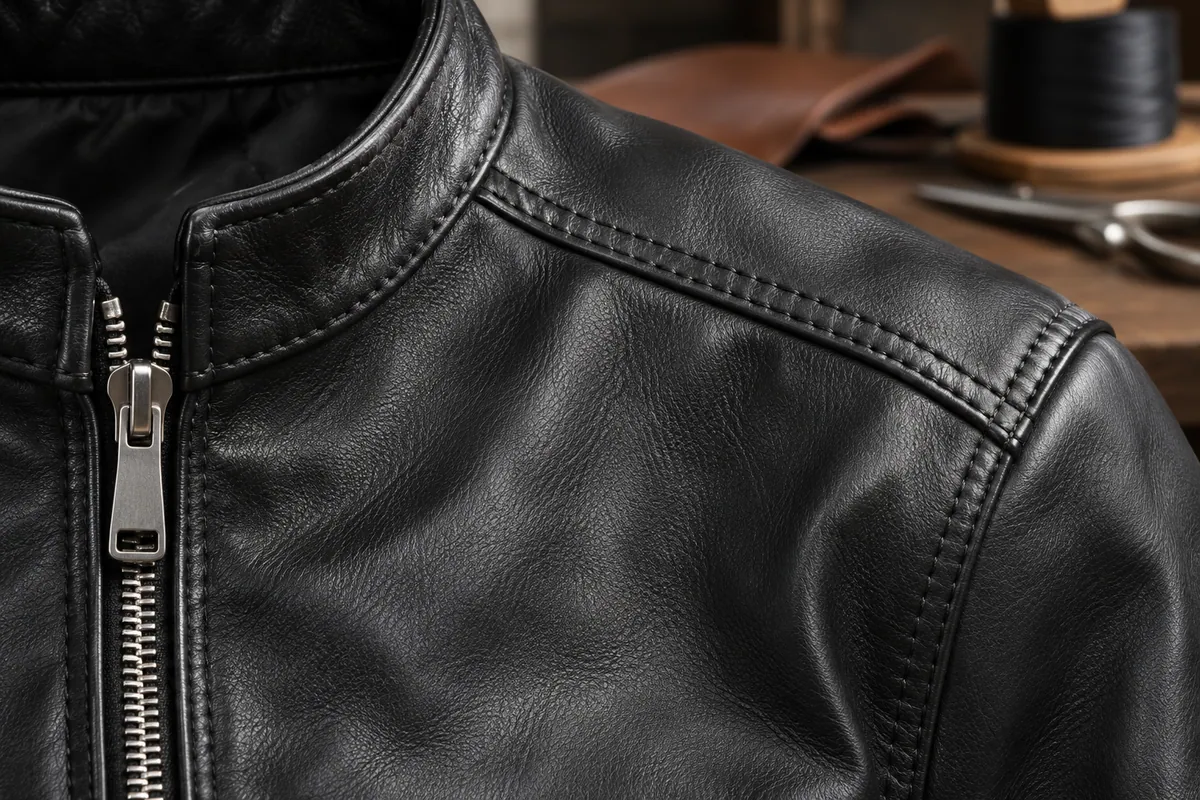
- Stitch length should be even, with no skipped stitches.
- Stress points (shoulders, underarms, pocket corners) should have reinforced or double stitching.
- Lines should be straight and thread tension even. No puckering.
- Loose threads on a new jacket are a warning.
We do not give a stitches-per-inch figure here because the right number depends on the leather weight and thread.
Hardware
Zips, snaps and rivets take the most wear.
- A zip should run smoothly with no snagging and sit flat when closed.
- Pull tabs and sliders should feel solid, not hollow or light.
- Snaps should click firmly and stay shut.
- Check plating for scratches or color mismatch.
Lining and pockets
The inside tells you how the maker worked.
- The lining should be sewn neatly with no twisting and enough room for your arms to move.
- Pockets should be deep enough for a phone and keys and stitched at the corners.
- Slide your hand into the sleeve. A good lining slips on easily without bunching.
Fit and pattern
A good jacket sits correctly on your shoulders. The shoulder seam should end at the shoulder bone. The sleeves should not twist when you hang your arms. Lift your arms and reach forward, then see if the jacket drags the hem up. Our women's buying guide covers fit for women. For men and unisex fit, common leather jacket sizing mistakes is a good next read.
Finish and edges
- Edges at the collar, cuffs and hem should be burnished or folded neatly, not raw and fraying.
- Dye should be even. Check the back of the leather at zip openings for color that rubs off.
- The surface should look natural, not painted on.
Red flags and price sanity
- A label that says only "genuine leather" and gives no grade.
- A very low price for a large amount of leather.
- A chemical smell that does not fade.
- A thin plastic-like feel.
- Seams that already pull apart.
Price alone does not prove quality. A high price can mean a brand markup. Check the points above instead.
Ten-point checklist
- Grade stated clearly (full-grain or top-grain).
- Flex test passes: fine wrinkles, no cracking.
- Natural leather smell.
- Even stitch length, no skipped stitches.
- Stress points reinforced.
- Zip glides and sits flat.
- Snaps and rivets feel solid.
- Lining clean, with deep pockets.
- Shoulder seam at shoulder bone.
- Edges finished, dye even.
Where a leather jacket is made or sold
A jacket made to order is likely to be a closer fit than one picked off a rack, because it is cut for you. Our made to order vs off the rack guide covers the differences. This is not to say that every ready-made jacket is poor. It means you should check points more carefully when you cannot see how a piece was constructed.
Buying online: what to check without touching the jacket
- Product description: does it say the grade of leather, or just "genuine leather"?
- Photos: look for close-ups of seams, zips and lining, not just a model photo.
- Measurements: a real size chart with sleeve, shoulder and length numbers beats vague sizes. See the size chart for how we list them.
- Reviews: read for repeated comments about zips, seams or smell.
- Return policy: know it before you buy.
How leather ages: what good quality looks like later
A well-made jacket does not stay new, and that is fine. Good leather develops a patina, with light creases at the elbows and slight darkening where it is handled. Poor leather peels, cracks or flakes at the surface. Seams on a good jacket stay closed, and zips keep working. For care, see leather longevity tips.
Quality by use: fashion vs motorcycle
A fashion jacket and a motorcycle jacket have different quality needs. A fashion jacket needs soft, thinner leather and neat finishing. A motorcycle jacket needs thicker leather, stronger seams, stronger zips and, for riding, protection that is certified. If a jacket claims to be protective, check what the product page says about armor and standards, and ask the maker. Do not assume a thick jacket is a protective one. See custom motorcycle jackets for riding-focused pieces.
What a workshop looks for
When a jacket is made, the cutter looks at the hide for scars and thin spots and places pattern pieces away from them. Pieces that sit side by side, such as the two fronts, should match in grain and shade. You can check this yourself: look at the two sleeves and the two front panels and see whether the color and grain match. A mismatch is not always a defect, but it is a sign of how carefully the hide was used. [VERIFY: workshop practice]
Quick tests you can do at home
- Lay the jacket flat and see if the seams line up on both sides.
- Hold a sleeve to the light to see if the stitching holes are even.
- Zip and unzip ten times to check for catching.
- Rub a corner of the lining. Fraying means cheap fabric.
- Smell the inside. A strong chemical odor can mean heavy finishing.
Quality at different price points
A higher price should buy you better leather, closer attention to details and stronger hardware. It does not guarantee any of those, which is why the checks matter. A mid-priced jacket with good grade, even stitching and solid zips beats an expensive one with a weak lining. Decide which points matter most to you, such as leather grade for longevity or fit for comfort, and check those first.
What to ask the seller
- What grade of leather is the jacket made from?
- Where is it made and what does that process involve?
- What is the lining made of?
- Can I return it if it does not fit?
- Is there any repair or alteration service? (We do not offer one after delivery, so choose your size with care.)
For an overview of fit, see how to choose the right fit and cut for your body shape.
FAQs
How can I tell if a leather jacket is good quality?
Check grade, stitching, hardware, lining and fit. If it fails on two or more, skip it.
What is the difference between full-grain and genuine leather?
Full-grain is the top layer with its natural surface. Genuine leather is real leather but often from lower layers and does not signal quality.
How many stitches per inch should a jacket have?
There is no single right number. Look for even, tight stitching suited to the leather. Ask the maker for their standard if you need a figure.
Is thicker leather always better?
No. Thickness should match the jacket's use. A fashion jacket needs softer, thinner leather than a motorcycle jacket.
How can I check the lining?
Slide your hand into the sleeve, check seams at the armhole and hem, and look at pocket stitching.
Does price show quality?
Not by itself. Judge the jacket on its points.
Want to see these points in your own jacket? Compare them on our custom leather jackets, and browse men's leather clothing.