 USA
USA  Canada
  Brazil
  Germany
  France
  Italy
Italy  Switzerland
  Sweden
  Spain
Spain  Great Britain
  Norway
  Russia
  South Africa
  Japan
Japan  Australia
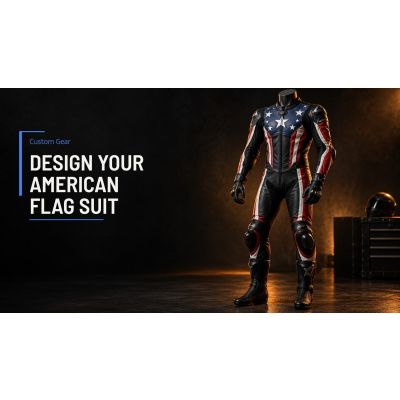
An American flag racing suit is a leather race suit whose panels carry the stars and stripes, either as a full flag layout or as red, white and blue colour blocking. The design works when the flag is planned around the cut of the suit rather than printed over it, because a suit is a bent, stretched shape and a flat flag layout distorts at the shoulders, elbows and knees. This guide covers how to read an American flag design, where the pattern sits on a one-piece or two-piece suit, how to size it, and what to ask when a custom version is wanted.
Key Takeaways
- The flag has 13 stripes and 50 stars, so a faithful layout needs enough clear panel area for the star field.
- Placement matters more than size: the chest, back hump, thighs and sleeves each stretch differently on a bike.
- Fit comes first. A flag design does not change how a suit should be measured or how its armour pockets should sit.
- Protection standards describe test requirements, not graphics. Ask for documentation of the armour option on the product page.
Reading the American flag as a suit design
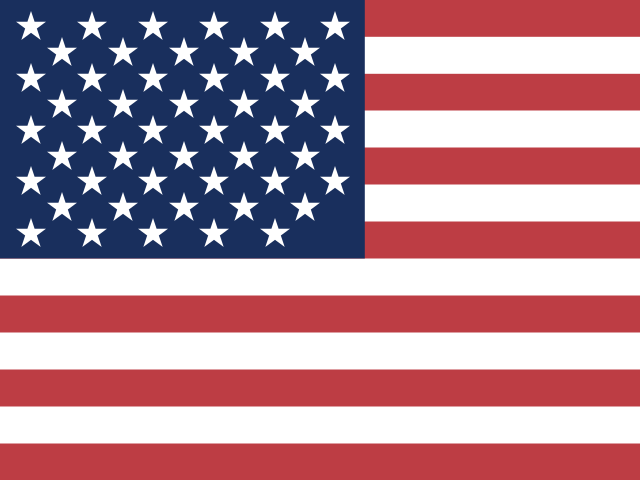
The flag of the United States has 13 stripes, which stand for the original British colonies, and 50 stars for the states. The current 50-star version was adopted on July 4, 1960 (Wikipedia, Flag of the United States). For a designer, that means three visual building blocks: a blue canton holding the stars, alternating red and white stripes, and a lot of high-contrast edges.
Those edges are the challenge. Thin stripes read clearly on a flat surface, but across a race suit they bend around the torso and break at every seam. Most flag suits therefore use one of three approaches.
Full flag layout
The star field sits on one panel, usually the chest or the upper back, with stripes running across the lower torso and legs. It is the most literal version and the most recognisable from a distance.
Stripes-led design
Broad red and white bands run along the arms and legs, with the stars kept to a smaller area such as the shoulder or the hump. Wider bands hide seam breaks better than thin ones.
Colour-block interpretation
Red, white and blue panels follow the suit's own seam lines, with a few stars as an accent. It is the easiest layout to keep clean, and it suits riders who want the colours without the full flag.
Where the pattern sits on a one-piece or two-piece suit
A one-piece suit gives the designer one continuous canvas, so the stripes can flow from the chest down to the thighs. The category of is where that style is usually found. A two-piece set joins jacket and trousers with a zip, and the waist line becomes a natural break in the design; the shows how a jacket and trousers can carry matching colours across the join.
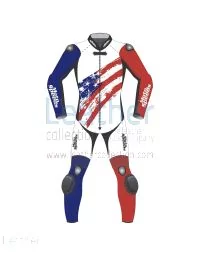
For a custom suit, the is the suit shown in an American-flag design in its product photos. The product page lists it as a one-piece or two-piece suit, with a choice of base colour and options such as hump style and perforation, and its colour list includes chrome finishes. The page describes the leather as drum-dyed milled cowhide, lists Monaco and kangaroo leather as upgrades, and describes hand-stitched, made-to-order construction with pre-curved sleeves for the riding position. A national design on a suit like this follows the same logic as any other: the colours are planned around the seam lines.
Check these four zones before approving any layout:
- Chest: the star field is easiest to read here, but it is also where the zip and collar interrupt the panel.
- Back and hump: a large flat area, useful for a bold flag, though the aero hump changes its shape.
- Sleeves: stripes running lengthwise stay straight when the arm is extended on the tank.
- Thighs and knees: stripes can look warped once the rider is tucked in, so keep knee sliders and panels clear of detail.
Fit and sizing for a flag-design suit
A graphic does not change the fit rules. A race suit is cut for the riding position, so measure in a relaxed stance and then check the stretch in the tuck. Take chest, waist, hips, inseam, sleeve and height, and compare them with the shop's size chart. A suit that fits standing but pulls across the back when leaning forward will also pull the flag out of shape.
For a rider choosing between standard sizes and a made-to-order suit, the design is a reason to take extra care. The star field is a clear reference point: if it sits low on the chest or drifts toward the shoulder when the suit is on, the proportions are off. The category shows the models, and the shop's size chart and made-to-measure page list the measurements requested.
| Measurement | Why it matters for a flag design |
|---|---|
| Chest | Sets the width of the star field and where the zip falls |
| Waist and hips | Decide whether stripes meet at the waist or break in the tuck |
| Sleeve | Keeps sleeve stripes from twisting at the elbow |
| Inseam | Controls the stripe position at the knee |
| Height | Affects the overall proportion of the layout |
Customisation: what to specify
A custom flag suit lives or dies on the brief. A clear order covers the layout style from the list above, the exact colour of each panel, the name or number position if one is wanted, and any panels that should stay plain. Colour references work better than words: "red" can mean anything from brick to bright signal red, and the same applies to the blue.
It also helps to say where the design must not go. Knee slider areas, the zip line and the armour pockets are better left clean. Check the product page and order form for the options it lists, such as one-piece or two-piece, colours, leather and speed hump choices, and ask whether the design can be adapted for the style chosen. Names, logos and race numbers are the rider's own choice, but any rider or team likeness is a separate matter; this type of suit is inspired by national colours, not by any team or championship.
Colour and finish
Leather takes colour in different ways depending on the dye and finish, and a bright white or deep blue can look different from one batch to the next. Ask for a sample or reference photo if the shade matters, and expect small variations between panels, as with any dyed leather.
Protection: what the graphics do not change
A flag design has no effect on protection. What counts is the leather, the stitching, the armour and the fit. In Europe, motorcycle clothing is assessed under the EN 17092 series, which has garment classes AAA, AA, A, B and C; SATRA notes that the series uses the Darmstadt abrasion method (SATRA, impact abrasion resistance of leather in motorcyclists' PPE). Those are requirements for a garment as tested by a lab, not a promise about any particular design, and no class is claimed here for any Leather Collection suit.
For a flag suit, the practical step is to read the order form: check the product page for the armour listed and ask for the documentation that applies to the suit before ordering. Treat graphics as cosmetic and protection as a separate checklist: armour position, seam construction and a fit that keeps the armour over the joint it covers.
Choosing a flag style that suits the rider
Track-day riders who want to be easy to spot often prefer the full flag layout, since the high-contrast stripes stand out against a pit wall. Riders who ride in mixed light may like colour-blocking with a smaller star field, which hides marks better and stays tidy as the leather ages. A contrast-heavy suit also shows scuffs more, so a layout with a dominant dark panel can look cleaner over time.
For a wider view of the range, the lists one-piece and two-piece suits in many colour schemes. Compare how each handles colour breaks before deciding how much of the flag to put on the suit.
Frequently Asked Questions
How many stars and stripes should an American flag race suit show?
The flag itself has 13 stripes and 50 stars, so a literal design shows both. A suit does not have to copy it exactly, though. Many designs reduce the stripes to broader bands or use a smaller star field so the graphic stays clear around seams, zips and panels. Decide how literal the layout should be before approving a design.
Which panel suits the star field on a race suit?
The chest and upper back give the most flat area, so they are the usual choice. The shoulder suits a smaller accent. Avoid the knees and elbows, where leather bends and distorts the stars. Whichever panel is chosen, check the position against the zip, collar and armour pockets before the design is final.
Does a flag design change how a race suit should fit?
No. Sizing follows the rider's measurements and riding position, not the graphic. A suit that pulls in the tuck will also warp the pattern. Measure chest, waist, hips, inseam and arm length, compare them with the size chart, and check that the armour sits over the joints. The design is cosmetic and the fit comes first.
Is an American flag racing suit safe to use on track?
Safety depends on the leather, the stitching, the armour and the fit, not the graphics. Check the product page for the armour option and ask for the documentation that applies. Standards such as EN 17092 describe what a garment must meet in a lab; they say nothing about how a particular crash ends. Always confirm what a track organiser requires.
Written by the Leather Collection Editorial Team.