 USA
USA  Canada
  Brazil
  Germany
  France
  Italy
Italy  Switzerland
  Sweden
  Spain
Spain  Great Britain
  Norway
  Russia
  South Africa
  Japan
Japan  Australia
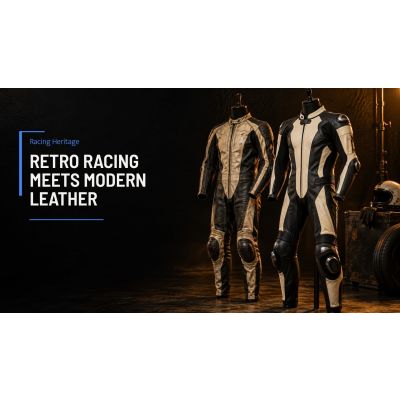
Retro race suits are motorcycle leathers that recreate the look of an earlier racing era, and a rider can get that look in two ways: by hunting for an original suit from the period, or by choosing a modern reproduction built to current patterns. The first is a collector's project; the second is the practical route for anyone who wants to ride in it. This guide explains how the two differ, what to look for, and how to judge a retro suit before buying.
Key Takeaways
- An original vintage suit is mainly a collectable; a reproduction is the usual choice for regular riding.
- Geoff Duke's early one-piece leather suit was made for streamlining, not safety, according to Wikipedia.
- Modern motorcycle clothing may be assessed under EN 17092, which uses a Darmstadt abrasion test; an old suit is unlikely to carry such documentation.
- Fit, seam condition and armour options matter more than the retro styling itself.
What Makes a Race Suit Look Retro
Retro styling is mostly a matter of restraint. Vintage-inspired suits tend to use large blocks of colour, a contrasting stripe down the sleeves and legs, a plain stand-up collar and a smooth leather finish. Modern suits, by comparison, often carry sculpted panels, stretch inserts and busy graphics. The old look is simpler because the original suits were simpler to cut and sew.
That history is worth knowing. According to Wikipedia's overview of motorcycle protective equipment, the one-piece racing suit evolved from the boilersuit and later the Sidcot suit used by pilots, and the first form-fitting one-piece leather suit is credited to Velocette's managing director around 1948. World champion Geoff Duke adopted it by 1950. The same source notes that Duke had his suit made for streamlining, not safety, and that most leathers of the time were made from horsehide.
Original Vintage Suits vs Modern Reproductions
An original suit has real period character, but it is a different object from a garment made today. Leather can stiffen and dry with age, stitching may weaken, zips can fail, and sizing follows the proportions of riders from another era. Armour in an old suit, if present at all, was not designed to current expectations. For these reasons, original suits are usually displayed, worn for photos or ridden at parade pace at most, and a rider should have any old suit inspected by someone who repairs leathers before using it.
A reproduction keeps the colours and layout but starts from a modern pattern. Whether it is cut for armour and a crouched riding position is something to check on the product page. Riders browsing this style can look through a collection to compare layouts, or move to the wider range if the exact period matters less than the cut.
| Point | Original vintage suit | Modern reproduction |
|---|---|---|
| Main purpose | Collecting, display, occasional wear | Regular riding in a retro look |
| Leather condition | Depends on age and storage | New leather, finish chosen by the maker |
| Fit | Period proportions, hard to adjust | Current size charts, often with sizing options |
| Armour | Often none, or period padding | Check the armour listed on the product page |
| Documentation | None to current standards | Ask the seller what documentation exists |
Protection and Standards: What a Retro Suit Does Not Tell You
Looking retro says nothing about protection. For modern motorcycle clothing the relevant reference is EN 17092. SATRA describes it as a series with parts for garment classes AAA, AA, A, B and C, where Class A is the lowest level of protection and Class AAA the highest. SATRA also notes that leather is tested for abrasion with the Darmstadt method, which is included in the EN 17092 series, using specimens mounted at set angles on the test machine.
This is useful context when reading any product description. A standard describes how a garment type is tested; it does not mean a particular suit has been tested or approved. Check the armour listed on the product page, and ask for the documentation before relying on a suit for track or road use. An original suit from several decades ago is unlikely to have any of this paperwork.
Protective thinking has also changed on the race track itself. According to Crash.net, since the 2018 season airbag-equipped suits have been compulsory for permanent riders in all classes of the MotoGP World Championship, with wild-card riders and replacement riders in their first two events excepted, which gives an idea of how far suits have moved from the streamlined leathers of the early 1950s.
How to Choose a Retro Suit
Decide how it will be used
If the suit is for shows, club events or photos, period accuracy can lead the decision. If it is for riding, put fit and armour first and let the styling follow. Production suits vary, so read each product page for its panel layout and options rather than assuming a retro look.
Get the fit right
Retro cuts may be slimmer than modern race suits, so measurements matter. Take chest, waist, hip, inseam and arm length, compare them with the size chart, and sit in a riding crouch to check the shoulders, back and knees. If standard sizes do not suit, ask about made-to-measure options.
Complete the look with matching gear
A retro suit looks unfinished with modern, brightly coloured accessories. Retro-styled and keep the look consistent. The product pages list the leather and construction of each item; check them for fit, protection and documentation as you would for the suit itself.
Be careful with rider-inspired designs
Many retro designs are inspired by famous riders' colours. These are style references only: a design inspired by a rider's suit does not come from that rider or team, and no suit should be described as if it did.
Looking After a Retro Suit
Follow the care label and the maker's instructions for any suit. The right product depends on the finish and construction of the leather, so a method that suits one suit may not suit another. For an old original, ask a leather repair specialist before applying anything, and ask how to store it.
Frequently Asked Questions
What are retro race leathers?
Retro race leathers are motorcycle racing suits that follow the look of an earlier era: simple panel layouts, contrast stripes, plain collars and a slimmer, less sculpted profile. Some are original suits from decades ago, and others are modern reproductions made to recreate that appearance with current patterns and materials.
Can an old leather suit be worn for riding today?
An original suit is a collectable first and a riding garment second. Leather ages, seams loosen and sizing differs from current patterns, and an old suit is unlikely to come with documentation to current standards. Riders who want to use a retro design on the road or track usually choose a modern reproduction and check its documentation.
Is a retro-style suit the same as a rider-inspired design?
Not necessarily. A retro-style suit borrows the look of a period without copying one rider's livery, while a design inspired by a rider's colours takes its look from a specific suit. Such a design has no link to that rider or team.
How should a retro suit fit?
A race suit is cut to be worn in a tucked riding position, so it can feel tight when standing. Measure chest, waist, hips, inseam and arm length, compare them with the size chart for the model, and check the fit while sitting in a riding crouch. Ask about made-to-measure options if standard sizes do not suit your proportions.
Written by the Leather Collection Editorial Team.