 USA
USA  Canada
  Brazil
  Germany
  France
  Italy
Italy  Switzerland
  Sweden
  Spain
Spain  Great Britain
  Norway
  Russia
  South Africa
  Japan
Japan  Australia
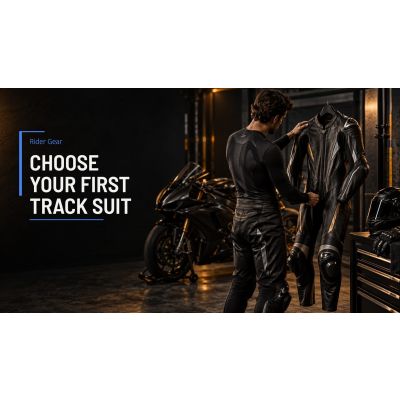
A first track day raises a handful of practical gear questions: one-piece or two-piece, which armour level, how snug a suit should feel, and whether a standard size is enough. Fit and armour placement strongly affect how well a suit works, so they deserve attention before brand, graphics or budget.
Key Takeaways
- A snug suit keeps armour over the joints it is meant to cover; a loose suit lets it drift.
- EN 1621 levels describe how much force an impact protector transmits. Level 2 transmits less than Level 1.
- EN 17092 classifies the whole garment. Classes AAA and AA require shoulder, elbow, hip and knee protectors.
- Measure chest, waist, hips and inseam and compare them with the maker's size chart. Non-standard proportions are the main reason to consider custom sizing.
What Makes a Race Suit Different From Street Gear
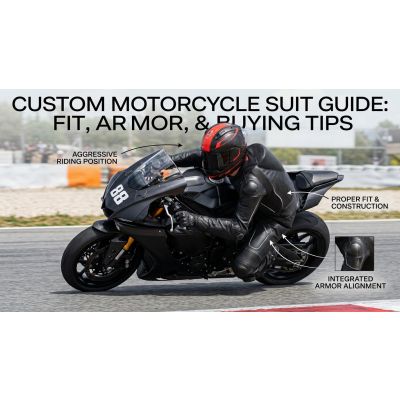
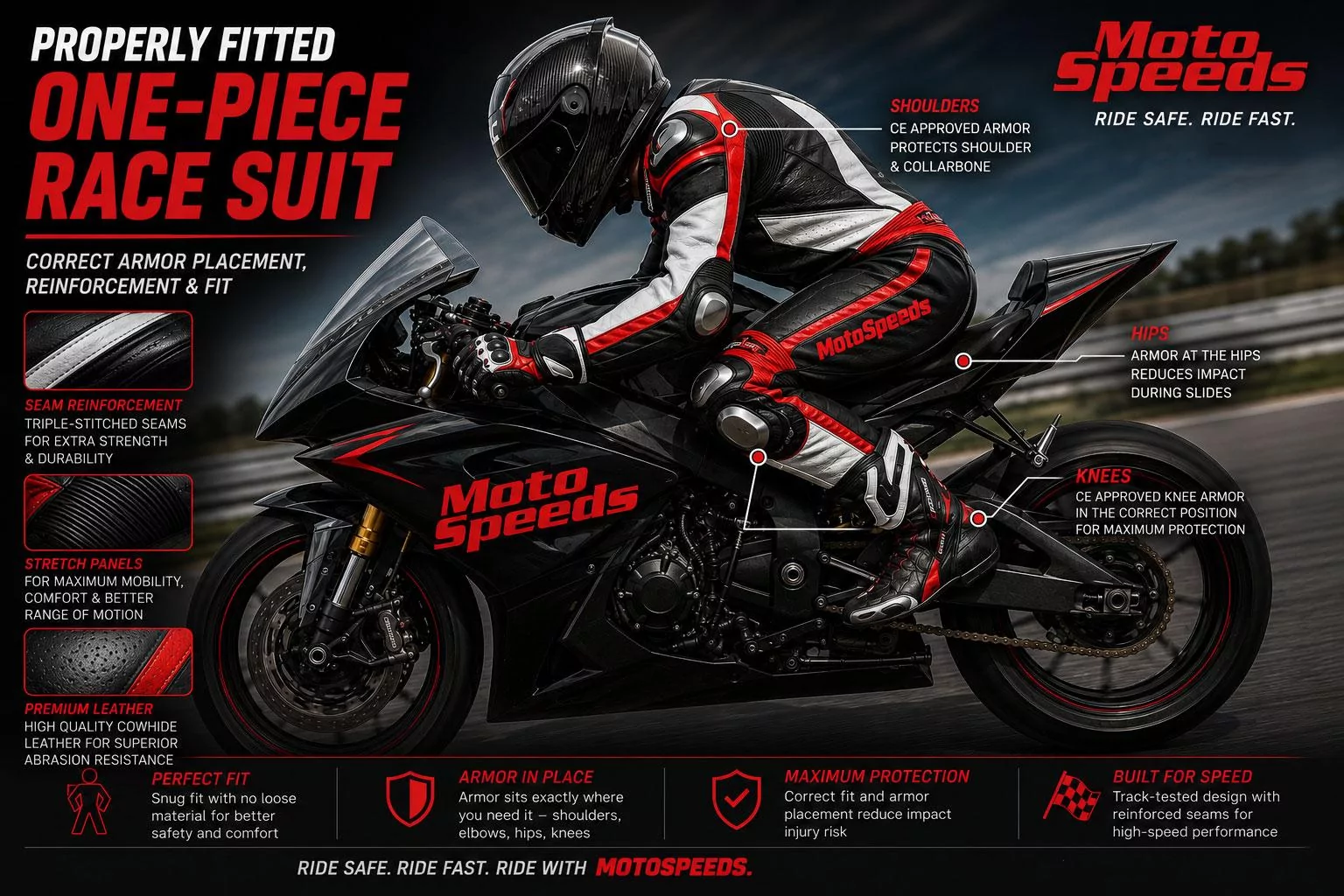
A motorcycle race suit is a one-piece or two-piece garment, usually leather, with armour at the shoulders, elbows, hips and knees and often a back protector. A street jacket favors comfort, ventilation and easy on-and-off. A race suit favors abrasion resistance, armour retention and a close, aerodynamic fit. It feels tighter off the bike and is harder to wear over everyday clothes. That closeness is deliberate: it keeps the suit and its protectors in place if the rider slides.
More material is not automatically more protection. A suit that fits and has correctly placed armour does more for a rider than a heavier suit that moves around the body. When comparing suits, put fit, armour type, armour position and seam construction ahead of thickness figures and brand names.
One-Piece or Two-Piece for a First Track Day
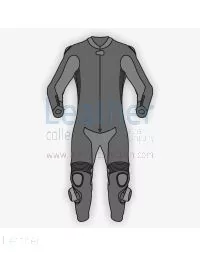
A one-piece suit has no waist join, so there is no gap between jacket and trousers where the lower back and hips can be exposed, and the close cut stays stable at speed. A two-piece suit is more flexible: the jacket can be worn on its own, and the pieces are easier to put on. A connecting zip around the waist, where the suit has one, makes a two-piece behave much like a one-piece on track. Riders weighing that trade-off can compare against one-piece designs.
Track day organisers publish their own kit requirements covering suit type, zips and protectors, so read them before ordering. A rider who also commutes in the suit may lean toward a two-piece; a rider who only rides track days and wants the cleanest fit tends to look at a one-piece. Browsing shows both formats side by side.
What EN 1621 Armour Levels Mean
Impact protectors are tested to the EN 1621 standard, which measures how much force passes through a protector when it is struck. The lower the transmitted force, the better the protector performs. EN 1621-1 covers limb joint protectors for shoulders, elbows, hips and knees: Level 1 requires a mean transmitted force below 35 kN with no single value over 50 kN, and Level 2 a mean below 20 kN. EN 1621-2 covers back protectors, with mean limits of 18 kN for Level 1 and 9 kN for Level 2 (Wikipedia: motorcycle armour).
Level 2 therefore transmits less force than Level 1 in the same test. Where the armour sits matters as much as its level: in the riding position, protectors should sit over the joint they cover. Removable armour can be repositioned to fit, and the maker's guidance should be checked on replacing protectors after a crash.
The back protector deserves its own check. Look for one tested to EN 1621-2, and for a pocket or fixing that holds it firmly in place when the rider is moving on the bike.
What EN 17092 Says About the Suit Itself
EN 1621 tests the armour; EN 17092 covers the garment. The standard has six parts: Part 1 sets the test methods, and parts 2 to 6 set requirements for classes AAA, AA, A, B and C. Classes AAA and AA require elbow, shoulder, knee and hip impact protectors, and hip protectors are optional in Class A. Class B gives abrasion protection equal to Class A but without impact protectors, and Class C covers only the areas where protectors sit, so it is meant to supplement another garment (SATRA). A listing that names the standard and class is easier to compare than one that only says "race grade".
How a Race Suit Should Fit
Fit is the factor riders most often underestimate. The right fit is snug but not restrictive. Standing upright, the suit should hug the body. In the riding position there should be enough stretch to grip the bars without the shoulders pulling back, and elbows, hips and knees should bend freely. There should be no bunching at the waist, no loose trouser legs and no sagging at the shoulders.
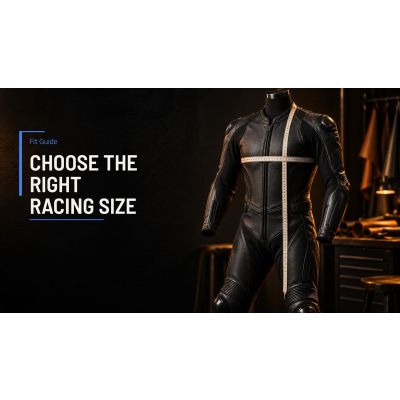
To size a suit, measure chest at its fullest point, natural waist, hips, inseam (crotch to ankle bone) and sleeve length, wearing the thin base layer used under the suit. Compare the numbers with the maker's size chart. If measurements fall between two sizes, ask the maker which size suits the intended base layer and riding position rather than guessing.
Buying a looser suit for comfort or versatility is a common mistake. A loose suit flaps at speed, and its armour can sit away from the joint. A suit that feels slightly restrictive in the shop is normal; one that feels roomy usually is.
Leather, Seams and Hardware to Check
Cowhide is widely used for race suits, and kangaroo leather is also used in motorcycle gear because it is strong for its weight. Makers list leather thickness in millimeters, which is useful for comparing like with like, but it says little about fit or armour position. Product pages such as and list leather, armour and construction details that can be checked against the points in this guide.
Seams hold the suit together under load. Look for multiple rows of stitching and extra reinforcement at the shoulders, underarms and thighs. Check the lining (a smooth lining makes the suit easier to put on), and confirm that zips are sturdy and have a lock or secure pull tab. Perforated or stretch panels add ventilation and mobility, but the armour positions should stay the same.
Standard Size or Custom Size
Standard sizing works when chest, waist, inseam and sleeve length all match one size on the chart. It stops working when proportions differ: a long torso with short legs, a wide chest with narrow hips, or arms and legs that run long or short for the torso. In those cases a standard suit leaves excess material in one place and pulls in another, and the armour ends up in the wrong position.
A made-to-order suit is cut from the rider's own measurements, so accurate measuring becomes the most important step. Follow the maker's measuring instructions exactly, and ask for help if a measurement is unclear. For a rider whose proportions fit the chart, standard sizing is usually enough for a first suit, and custom sizing can follow once the rider knows how a suit should feel.
shows how fit options are described on a listing.Final Checks Before the First Track Day
Three decisions cover most of the purchase: the armour level, the size and proportions, and the format (one-piece or two-piece). After that, work through a short checklist.
- Try the suit on with the base layer that will be worn under it.
- In the riding position, check that armour sits over the knees, hips, elbows and shoulders.
- Check grip on the bars, movement on the seat and reach to the controls.
- Confirm the back protector is tested to EN 1621-2 and is held in place.
- Read the track day organiser's kit rules.
Wearing the suit for a full session before the event shows whether it shifts or pinches. Examples across formats are collected in
.Frequently Asked Questions
What is the difference between a race suit and a street leather jacket?
A race suit is built to stay in place and limit sliding, with a close fit, armour positioned over the joints and reinforced seams. A street jacket favors comfort and ease of wear and is cut looser. Fit is the main difference in practice: a suit that moves on the body cannot hold its protectors over the joints they are meant to cover.
Should a first track day suit be one-piece or two-piece?
A one-piece suit has no waist join and a stable fit, which is why many track riders prefer it. A two-piece suit is more flexible for street use and can be zipped together at the waist for track riding. Check the track day organiser's kit requirements first, since they may specify which formats are accepted.
What do CE Level 1 and Level 2 armour mean?
Both refer to EN 1621 impact tests. Level 1 limb protectors transmit a mean force below 35 kN with no single value over 50 kN, and Level 2 a mean below 20 kN. For back protectors the limits are 18 kN and 9 kN. A lower transmitted force means the protector passes less of the impact to the body, so Level 2 performs better in the test.
How do I know whether a race suit fits correctly?
It should feel snug standing up, with no loose material at the waist, shoulders or legs. In the riding position, the rider should be able to grip the bars, bend elbows and knees freely and move on the seat. Armour should sit over the joints it protects. Measure chest, waist, hips, inseam and sleeve length, and compare them with the size chart.
When is custom sizing worth considering?
Custom sizing helps riders whose proportions do not match any single size on the chart, such as a long torso with short legs. A made-to-order suit is cut from the rider's own measurements, so precise measuring matters. Riders whose measurements match a standard size can usually start with that size.
Written by the Leather Collection Editorial Team.